
The Day the Math Changed
Before my son was born, I built cars the way a fighter trains — for peak output, for the edge, for the moment when everything you have is on the line. A car was a tool for testing myself. If it bit back, that was part of the exchange. I accepted the risk because the risk was mine to take.
Mason arrived on a Tuesday in March. I remember holding him in the hospital room, his hand wrapped around my finger, and thinking something that had never crossed my mind in twelve years of building performance cars: I need to be here tomorrow.
That thought rewired everything. Not instantly. It took months to work its way through my hands and into the parts I chose, the tunes I wrote, and the way I pulled out of the driveway. But it started that night, and it has not stopped.
Fatherhood did not make me slow. It made me precise. There is a difference, and anyone who does not understand it has never had a small person waiting at the door.
The New Hierarchy of a Build
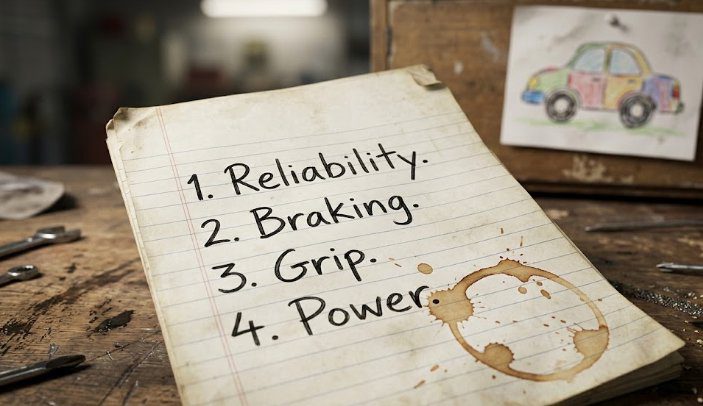
Before kids, my build priority list looked like this: power, grip, braking, reliability. In that order. I was willing to tolerate a car that ran hot in traffic if it meant hitting a horsepower target. I would accept a clutch that was miserable in stop-and-go if it held the torque. Compromises were justified by the goal. The goal was a number, a feeling, a win.
After kids, the list inverted. Now it reads: reliability, braking, grip, power. The first question I ask about every modification is not “what will this add?” It is “what will this take away?” Will this intercooler keep intake temperatures stable on a 95-degree day with the AC running and two kids in the back? Will this fuel pump maintain pressure after a heat-soaked restart in a parking lot? Will these brake pads stop the car in the wet when someone else’s kid runs into the street?
The power still matters. I still love a hard pull and a clean shift. But power is only acceptable if the systems around it are overbuilt. Margin used to be a luxury. Now it is a requirement.
The Parts That Got Reconsidered
Some specific things changed in the garage after Mason and Nora entered the picture. I found myself looking at parts I had run for years and asking harder questions.
Tires
I used to chase maximum lateral grip with little regard for wet performance or cold-weather behavior. Now I run tires that communicate clearly at normal speeds and work in the rain. A 200-treadwear track compound has no place on a car that might carry my children home through a summer thunderstorm.
Brakes
I mentioned this in an earlier piece, but it bears repeating here. Pad compound is the most overlooked safety system on a modified street car. Factory pads are designed for low noise and low dust, not for a panic stop from 70 mph with a full load. Performance street pads that bite cold are not optional if your car makes more power than stock. They are a moral obligation.
Cages and Harnesses
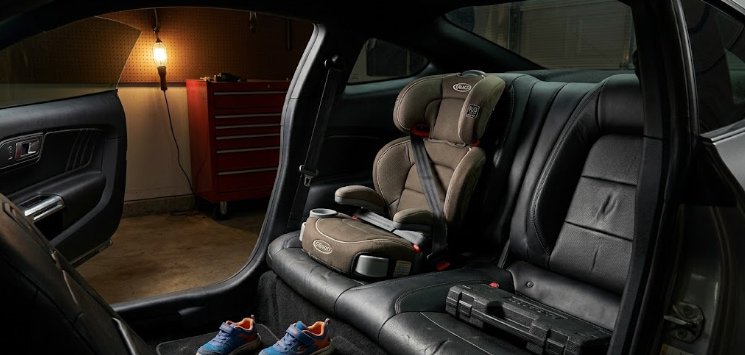
This one gets controversial. A half-cage and fixed-back racing seats with harnesses look serious. They also make the rear seat unusable for child seats and turn a simple errand into a wrestling match with a six-point belt. More importantly, a harness without a proper cage and a HANS device can be more dangerous than a factory three-point belt in a street accident. I pulled the harness bar out of my weekend car. My kids need to ride in it sometimes. That means stock belts, stock seats, and full airbag functionality. No compromises on safety engineering.
Tuning
My personal tune files now include a valet mode and a low-boost map that I can switch to with a button. When the car has my family inside, it runs wastegate pressure. The full-power map is for an empty car and an open road. Separating those two states took an afternoon of tuning work. It is the best hour I ever spent with a laptop.
The New Risk Calculus
Here is something I do not hear discussed often enough in car culture: every car is a weapon when it is moving. The energy a 3,500-pound vehicle carries at highway speed is enough to erase a life in an instant. I knew that intellectually when I was twenty-five. I did not feel it in my bones until I had children.
Now I drive with a constant awareness of consequence. Not fear — fear is a bad co-pilot. Awareness. I leave larger gaps. I scan intersections longer. I do not take the kind of risks on public roads that I might have accepted a decade ago. The car is more capable than it has ever been. I am more restrained than I have ever been. That combination works.
This is not about becoming boring. It is about understanding that the most impressive thing a fast car can do is come home in one piece, night after night, year after year. A build that cannot do that is a failure of judgment, no matter what it runs in the quarter mile.
What I Want My Kids to See
Mason is ten now. He comes into the garage sometimes and hands me tools. He asks questions about what I am doing and why. Nora is seven and mostly interested in whether the car has a good song on the radio. Both of them are watching me in ways they will not remember consciously but will absorb permanently.
I want them to see a father who cares about doing things right. I want them to understand that a fast car is a serious responsibility, not a toy. I want them to learn that the best thing you can build with your hands is something that lasts, something you trust, something that does not let people down.
If they remember nothing else about the garage, I hope they remember this: the car was never more important than the people inside it.
The Bottom Line
Fatherhood did not take speed away from me. It gave speed a context. A car that can carry my family safely through traffic, then run hard on a back road when I am alone, is a far more impressive machine than a car that can only do one of those things. Building to that standard requires more thought, more restraint, and more honesty than building for a dyno number ever did.
If you are a father who builds cars, I do not need to convince you of any of this. You already know it in your hands and in your gut. If you are not yet a father, file this away. One day, you might find yourself in a garage at midnight, looking at a freshly installed part, and asking a question you never used to ask: will this keep them safe?
When you ask that question honestly, you are no longer assembling a car. You are building one.