
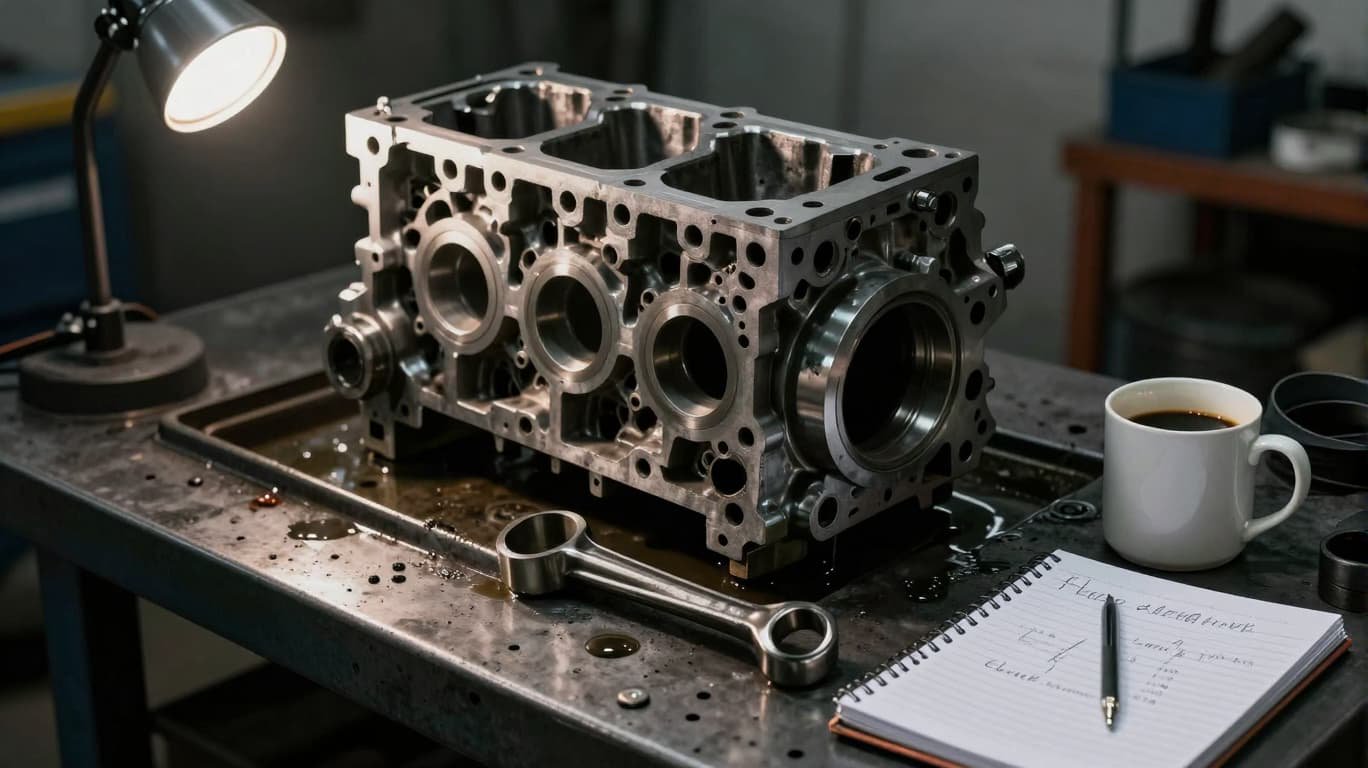
The Lessons That Perfection Never Teaches
A car that never breaks is easy to respect. It starts cold, pulls clean, and asks for nothing but fuel and oil. You drive it, you enjoy it, and you never think about it. That is a good car. But it is not a great teacher.
The cars I respect most are the ones that broke. Not the ones that failed from neglect — those are just sad stories. The ones that broke because someone asked too much of them, or because a single bad decision cascaded into a mechanical event, or because a part that looked strong on paper turned out to be weak in practice. Those cars taught me more about engineering, patience, and the limits of a system than any dyno graph ever could.
I have rebuilt engines that punched a rod through the block at 7,000 rpm. I have diagnosed transmissions that shredded third gear because the clutch was rated for the torque but the driver’s left foot was not. I have re-wired entire engine bays after a single chafed sensor ground caused a misfire that took two weeks to trace. Every one of those cars left my shop in better condition than it arrived. And every one of them had my respect in a way it did not before it failed.
The Small-Block That Taught Me Margin
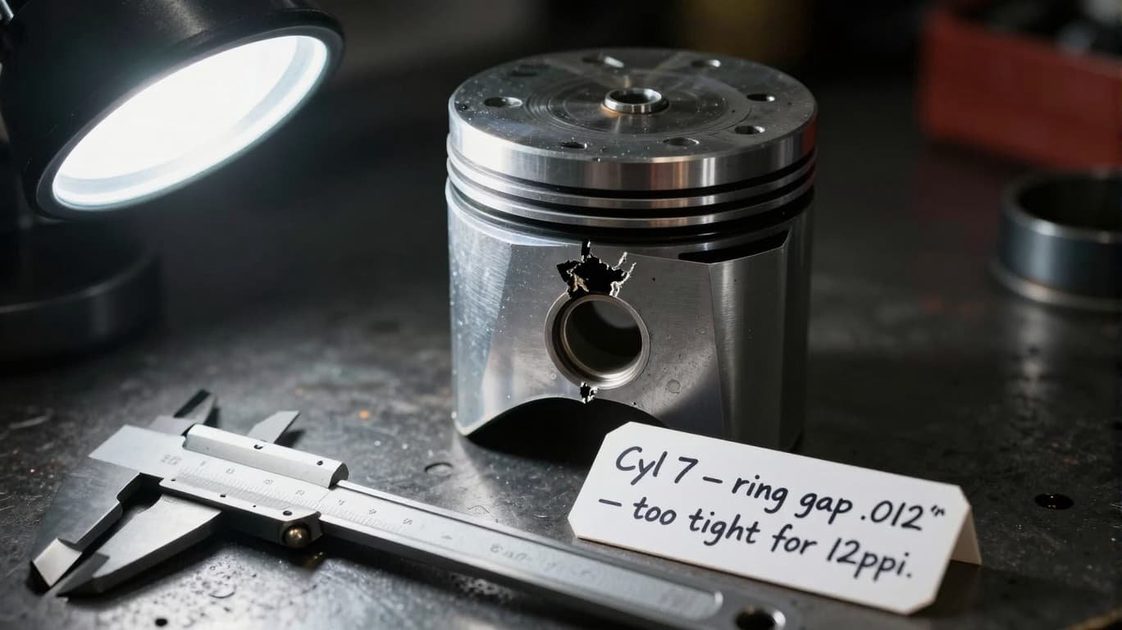
The first engine I ever built myself was a small-block V8 for a third-generation Camaro. I was twenty-four, cocky, and convinced that more compression and more camshaft duration equaled more power. The math worked on paper. The engine made power on the dyno. It lasted six hundred miles on the street.
The ring gaps were too tight for the cylinder temperatures the engine saw under sustained load. The piston expanded, the ring ends butted, and the ring land cracked on cylinder seven. The engine did not grenade — it just started smoking and losing power. I limped it home, pulled it apart, and stared at my mistake for an hour.
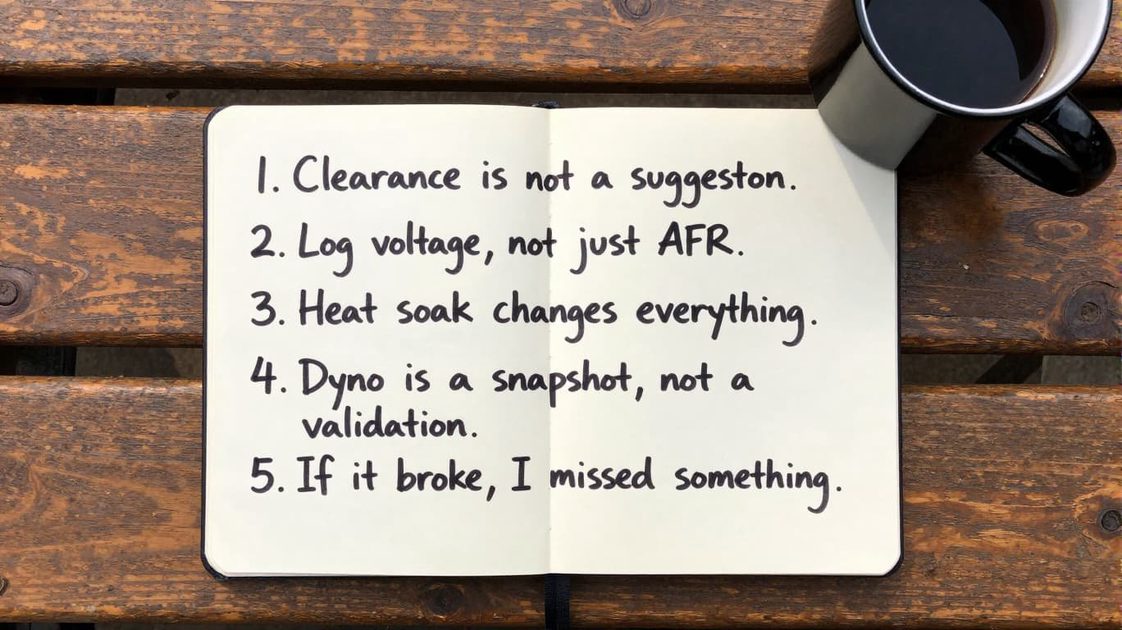
That engine taught me that clearance is not a suggestion. It is the distance between a running engine and a boat anchor. It taught me that the factory specs exist for a reason, and exceeding them requires understanding the thermal expansion of every part in the rotating assembly, not just the peak power number. I rebuilt that engine with proper ring gaps, wider bearing clearances, and a cooling system that could handle the heat. It ran for 60,000 miles after that. I never trusted a piston ring gap calculator I had not verified myself again.
The Import That Humbled a Shop
A few years later, a turbocharged all-wheel-drive import came into the shop on a tow truck. The owner had paid a reputable tuning shop to build the engine and calibrate the ECU. The dyno sheet showed 420 wheel horsepower. The car drove beautifully for three weeks. Then it melted a piston during a highway pull.
The owner was furious at the shop. I pulled the engine down and found the failure: the factory fuel pump had been retained, and the voltage to the pump was dropping under sustained high-RPM load. The pump still flowed enough fuel at 13.5 volts. At 12.0 volts, which it saw when the alternator was heat-soaked and the radiator fans were running, it did not. The engine went lean. The piston melted.
That car taught me that a dyno tune is a snapshot of a moment, not a validation of the system. It taught me to log voltage, fuel pressure, and intake air temperature under every condition the car would see — not just wide-open throttle in third gear on a cool morning. The shop that built the engine was not incompetent. They were incomplete. That car forced me to become complete.
The Muscle Car That Refused to Die
Not every broken car teaches a lesson about failure. Some teach a lesson about durability. A customer once brought me a 1970s American muscle car that had been sitting in a barn for fifteen years. The engine turned over by hand. The fuel system was varnished. The wiring was a fire hazard. The owner wanted it running for his son.
I expected a nightmare. Instead, I found an engine that had been built with nothing more exotic than factory parts, conservative clearances, and a carburetor that was easy to tune. The cylinder walls still showed crosshatching. The bearings were worn but serviceable. The car fired up on the third crank after a fuel system flush and a set of points.
That car taught me that simplicity is a survival strategy. It did not make big power. It did not rev to the moon. It was not optimized. What it was, was robust. It had margin everywhere — in the bearing clearances, in the ring gaps, in the cooling system capacity. It was under-stressed and over-built, and it survived decades of neglect because of it. I respected that car more than many exotics I have worked on. It knew what it was, and it refused to die.
What the Broken Cars Had in Common
I have kept a mental list of every engine failure I have diagnosed over twelve years. The causes vary, but the themes repeat. The table below is not comprehensive. It is representative of the mistakes that show up most often and the lessons they carry.
What Failed | Why It Failed | What It Taught Me |
|---|---|---|
Cracked piston ring land | Ring gaps too tight for boost and cylinder temperature | Thermal expansion is not optional math |
Spun rod bearing | Oil starvation during sustained high-G cornering | Oil control is a system, not a pan and a pump |
Melted piston | Fuel pump voltage drop under heat-soaked conditions | Log voltage and pressure, not just AFR |
Burned exhaust valve | Tune too lean at part throttle during highway cruise | Tune all load cells, not just wide-open throttle |
Stripped third gear | Clutch that grabbed hard, driver that slammed gears | Driveline shock loads break things that torque ratings say will survive |
Cracked turbo manifold | Heat cycles, no flex section in the exhaust, thermal stress | Exhaust systems move, and rigid connections break |
The common thread is not that the parts were cheap. In most cases, they were not. The common thread is that the system was not considered as a whole. One parameter was optimized, and the surrounding parameters were ignored until they failed.
Why I Trust Broken Cars More
A car that has never broken is an unknown. It has not been tested to its limit, so its limit is theoretical. A car that has broken, been diagnosed honestly, and been rebuilt correctly is a known quantity. Its weak points have been exposed and addressed. Its limits have been mapped. Its builder knows exactly what it will tolerate and what it will not.
I trust a rebuilt engine with 10,000 miles on it more than a fresh engine with 500 miles on it. The fresh engine is still in the infant mortality phase — the period where assembly errors, defective parts, and tuning mistakes reveal themselves. The rebuilt engine has already passed through that phase and survived. It has a history. History is a form of proof.
The cars I respect most are the ones that broke, taught a hard lesson, and came back stronger. They are not the prettiest cars. They are not the fastest cars on a spec sheet. They are the cars that have been through something — a mechanical event, a rebuild, a period of reflection — and emerged on the other side with their weaknesses corrected and their character intact.
A car that has never failed you has not yet taught you everything it knows. The ones that break are the ones that force you to pay attention. When you pay attention, you learn. When you learn, you become a better builder, a better driver, and a better judge of what matters.
The Bottom Line
Respect is earned in different ways. Some cars earn it by never giving trouble. Those cars are easy to love. The cars I respect deeply are the ones that broke my heart, drained my wallet, and forced me to understand something I thought I already knew.
If your car has just failed, you are not at the end of the story. You are at the beginning of the education. Diagnose the failure honestly. Fix the system, not just the broken part. Rebuild with the knowledge the failure gave you. The car that comes out of that process will be better than the one that went in.
And you will trust it more, because you know exactly what it took to break it the first time. That is not a weakness. That is a warranty written in experience.