The Noise That Lies
I can hear a bad exhaust from three blocks away. Not bad in the moral sense. Bad in the mechanical sense. The drone that rattles windows but produces no forward motion. The crackle tune that sounds like gunfire and does nothing for the torque curve. The straight-pipe setup that screams at wide-open throttle and punishes the driver at every cruising speed in between.
The aftermarket sells volume because volume sells itself. A loud car feels faster. The driver presses the throttle and the cabin fills with sound. The brain interprets that sound as speed because sound is immediate and visceral. A dyno graph requires interpretation. A exhaust note requires nothing. It hits the ears and the chest and tells a story that may or may not be true.
I have driven cars that sounded like they made 500 horsepower and actually made 280. I have also driven cars that were nearly silent at cruise and pulled like a freight train when the throttle opened. The correlation between volume and power is not zero, but it is far weaker than the exhaust industry wants you to believe.
Loud is not fast. Loud is just loud. Confusing the two is one of the most expensive mistakes a street car builder can make.
What an Exhaust System Actually Does
An exhaust system has three jobs. Producing a pleasing sound is fourth on the list, and it should never come at the expense of the first three.
Job 1: Evacuate Combustion Gases
The exhaust must carry hot, high-velocity gas from the cylinder head to the atmosphere with minimal restriction. Restriction creates backpressure. Backpressure increases exhaust gas temperature, reduces volumetric efficiency, and robs power. This is why a properly sized exhaust makes more power than a restrictive stock system.
Job 2: Manage Exhaust Velocity
Exhaust gas moves in pulses, not a steady stream. The diameter of the exhaust tubing determines the velocity of those pulses. Tubing that is too large slows the pulses down. The gas cools and stagnates. Scavenging — the process by which one exhaust pulse helps pull the next pulse out of the cylinder — weakens or disappears. The engine loses torque, especially at low and mid-range RPM where a street car spends most of its life.
Job 3: Control Noise Without Losing Flow
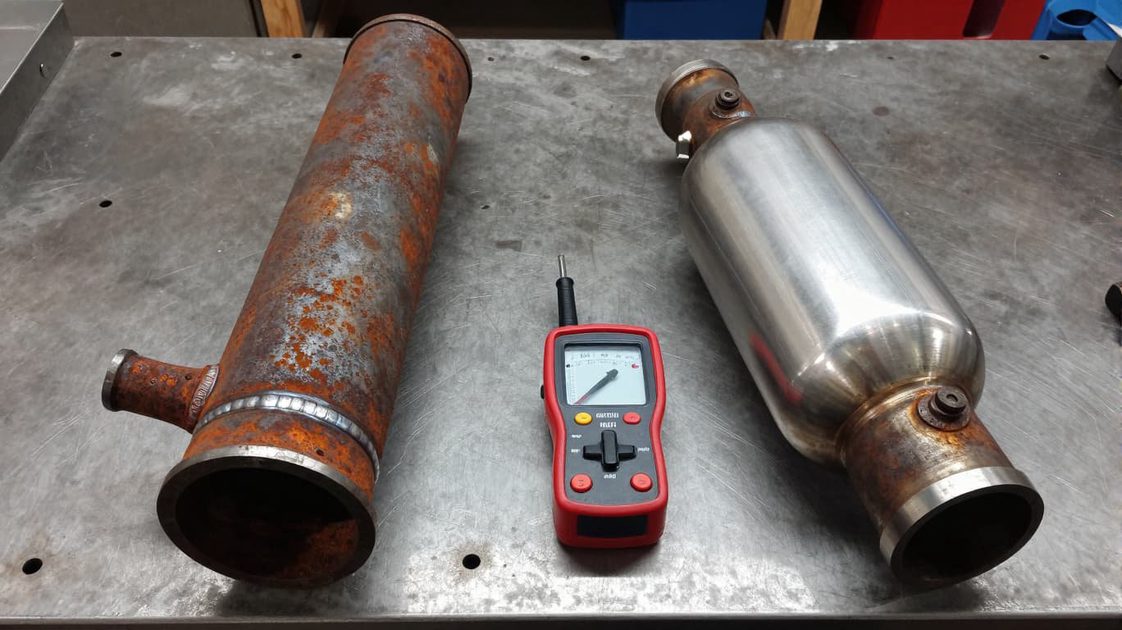
Mufflers and resonators are not power robbers when they are designed correctly. A straight-through muffler with a perforated core and sound-absorbing packing material can flow nearly as well as an open pipe while reducing noise to a level that does not cause hearing damage or police attention. A poorly designed chambered muffler with abrupt internal transitions can create restriction and turbulence that cost power. The difference is in the engineering, not the volume knob.
The Exhaust Table
What They Installed | What They Expected | What Actually Happened |
|---|---|---|
Three-inch straight pipe, no muffler, no resonator | Maximum horsepower gain | Drone at 2,500-3,500 RPM, no power gain over a well-designed muffled system, permanent hearing fatigue on highway trips |
Cat-back with oversized piping on a naturally aspirated engine | More power across the rev range | Lost low-end torque, throttle response softened, car felt slower in normal driving |
Aggressive pop-and-crackle tune | Sounds like a race car | Raw fuel dumped into exhaust on deceleration, washed cylinder walls, fouled spark plugs, burned exhaust valves over time |
Stock exhaust, properly sized downpipe upgrade | Improved turbo spool and flow | Noticeable power gain, slightly deeper tone, no drone, no police attention |
Quality cat-back with straight-through muffler and Helmholtz resonator | Better sound and flow | Moderate volume increase, zero drone at cruise, full-throttle sound was aggressive but not obnoxious, measurable power gain on turbocharged application |
The right column on the bottom two rows is what happens when the exhaust is treated as a system rather than a volume knob. The goal is not silence. The goal is sound that communicates what the engine is doing without overwhelming the cabin or the neighborhood.
Why Loud Exhausts Cost More Than Money
The financial cost of a bad exhaust is the least of it. A cheap straight-pipe setup costs less than a quality cat-back, which is why so many builders choose it first. The real costs accumulate elsewhere.
Drivability
Drone is not a minor annoyance. It is a specific frequency range — usually between 2,000 and 3,500 RPM — where the exhaust resonance matches the cabin's natural frequency. The result is a pressure wave that makes conversation impossible, listening to music pointless, and highway driving exhausting. A car that drones on the highway is a car you will find excuses not to drive.
Attention
A loud exhaust announces your presence to everyone within a half-mile radius. That includes law enforcement. It includes your neighbors at 6 a.m. It includes every other driver on the road, some of whom will respond to the noise with aggressive behavior. A car that attracts the wrong kind of attention is a car that becomes a liability.
Mechanical Damage
Crackle tunes are not harmless. They work by dumping raw fuel into the exhaust on deceleration, where it ignites in the hot pipes. The combustion event that produces the popping sound also produces pressure spikes and heat that the exhaust system was not designed to contain. Over time, this destroys catalytic converters, burns exhaust valves, and damages turbocharger turbine wheels. The sound is temporary entertainment. The damage is permanent.
What a Good Exhaust Sounds Like
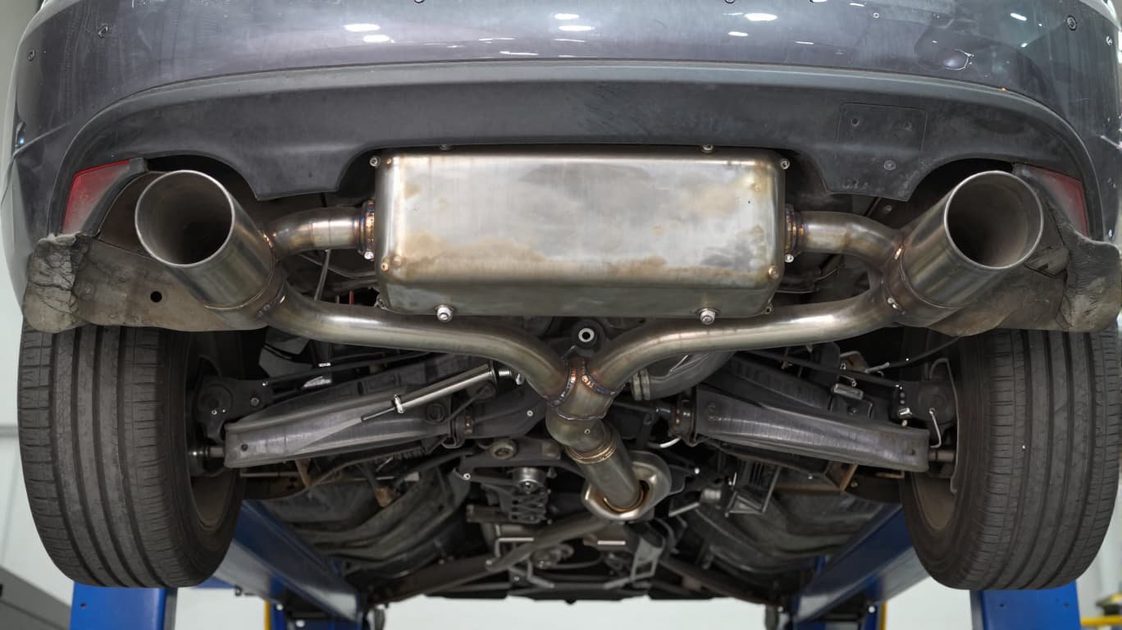
A good exhaust does not need to be quiet. It needs to be deliberate. At idle, it should have a clear, even pulse — not a choppy, misfiring lope unless the engine actually has a camshaft that produces that idle characteristic. At part throttle and cruise, it should recede into the background, present but not intrusive. At wide-open throttle, it should rise in volume and sharpen in tone, communicating the engine's load and RPM without distortion or rasp.
The best exhaust systems I have installed did not sound like they were trying to impress anyone. They sounded like the engine, amplified and clarified. A V8 sounded like a V8, not a chain of firecrackers. A turbocharged four-cylinder sounded like a turbocharged four-cylinder, not a vacuum cleaner. The sound matched the mechanical character of the engine. It did not try to be something the engine was not.
The Rule I Follow
On a street car, the exhaust should be no louder than it needs to be to achieve the required flow. If the engine makes 400 wheel horsepower, the exhaust should be sized to support 400 wheel horsepower with minimal restriction — and no larger. If a straight-through muffler and a resonator achieve that flow with acceptable volume, the system is finished. There is no need to remove the muffler to chase a sound that adds nothing to the power curve.
The dyno does not measure decibels. The drag strip timing lights do not respond to exhaust noise. A car that is quiet at cruise and ferocious at full throttle is a far more impressive engineering achievement than a car that screams constantly and goes nowhere.
The Bottom Line
Loud is an aesthetic choice. Fast is a mechanical outcome. The two are related only by the quality of the engineering between the cylinder head and the tailpipe.
If you want to be loud, be loud. But do not confuse the noise with power. Do not sacrifice drivability, reliability, or the goodwill of your neighbors for a sound that impresses people who do not understand the difference. A car that sounds like it is doing 150 miles per hour while merging onto the highway at 55 is not a performance car. It is a performance.
Build the exhaust for the engine. Size the piping for the flow. Choose the mufflers for the tone. Then drive the car and let the sound be the result of the work, not the goal of it. Good power is usable power. Everything else is just noise.