The Most Overlooked Performance Part
Walk through any modified car meet and look at the tires. Really look. You will see cars with big turbo kits and all-season rubber. Cars with six-piston brake upgrades and 400-treadwear touring tires. Cars with adjustable coilovers set to track stiffness, riding on the same budget performance tires the owner bought when the car was stock three years ago.
These are not hypothetical examples. I have seen them in Brooklyn, in New Jersey, at events and in shop parking lots. The owner spent two thousand dollars on a turbo upgrade, fifteen hundred on coilovers, eight hundred on a cat-back exhaust, and zero dollars on the only part of the car that actually touches the road.
A tire is not an accessory. It is not a visual modification. It is the mechanical interface between every decision you have made and the pavement that decides whether those decisions work. A car with 500 horsepower and bad tires is slow. A car with 200 horsepower and great tires is quick. The difference is not the engine. The difference is grip.
What a Tire Actually Does
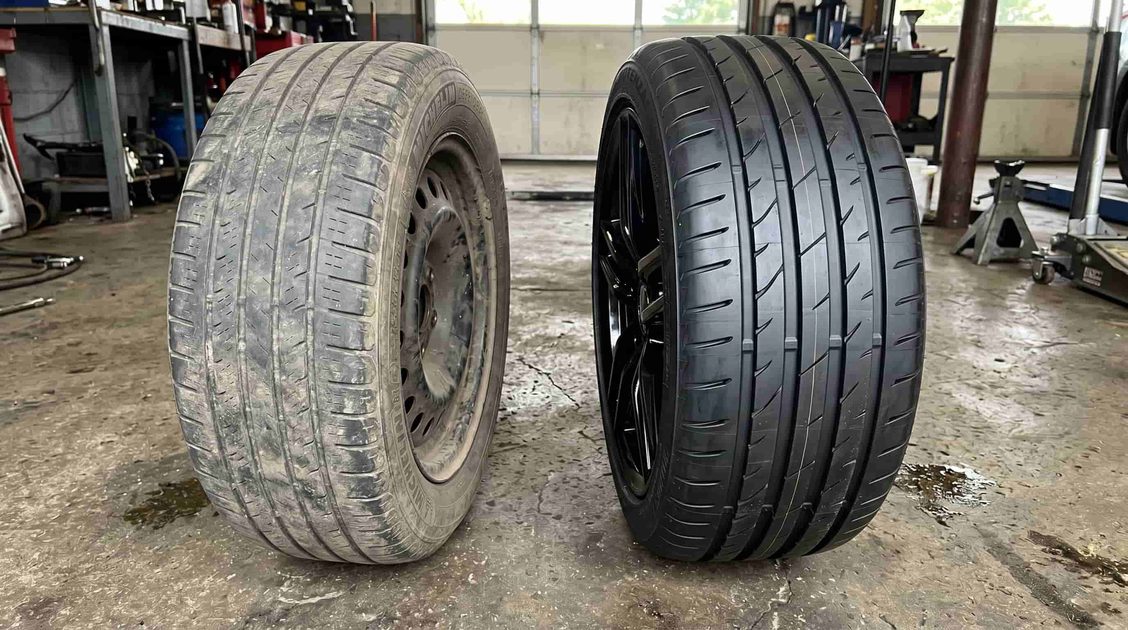
A tire performs four jobs simultaneously. It supports the weight of the car. It transmits acceleration and braking forces to the road. It generates lateral grip during cornering. It absorbs small road imperfections that would otherwise reach the suspension. Every other performance part depends on these four jobs being done well.
A turbocharger generates torque. If the tires cannot transmit that torque to the road, the torque becomes wheelspin — noise and smoke and no forward progress. A big brake kit generates stopping force. If the tires cannot convert that force into friction against the pavement, the ABS activates early and the car stops longer than it should. A coilover suspension manages weight transfer. If the tires cannot hold the road during that transfer, the car understeers or oversteers regardless of spring rate.
The tire is the limiting factor in every performance equation. It is the bottleneck that makes every other upgrade either functional or decorative. A build that ignores the bottleneck is not a build. It is a collection of potential that never reaches the ground.
The Tire Table
What They Did | What They Expected | What Actually Happened |
|---|---|---|
Big turbo upgrade, stock all-season tires | Faster acceleration | Wheelspin through third gear, slower than stock off the line |
Six-piston brake kit, 500-treadwear touring tires | Shorter stopping distance | ABS cycling constantly, stopping distance limited by tire friction not caliper force |
Full coilover suspension, budget summer tires | Sharper handling | Sidewall flex absorbed steering input, sloppy turn-in despite stiff springs |
400whp dyno tune, four-year-old tires with heat cycles | Quick lap times | Tires lost grip progressively, unpredictable breakaway, no confidence |
Lightweight wheels, low-rolling-resistance tires | Better steering feel | Hard compound reduced grip, car felt disconnected and numb |
The pattern is consistent. An expensive performance part is installed upstream of a tire that cannot support it. The part functions correctly. The car does not improve. The owner blames the part, or the tuner, or the car. The tire was the limitation all along.
How to Choose a Performance Street Tire
Tire selection is not about buying the widest, stickiest, most extreme tire on the market. It is about matching the tire to the car, the climate, and the way you actually drive.
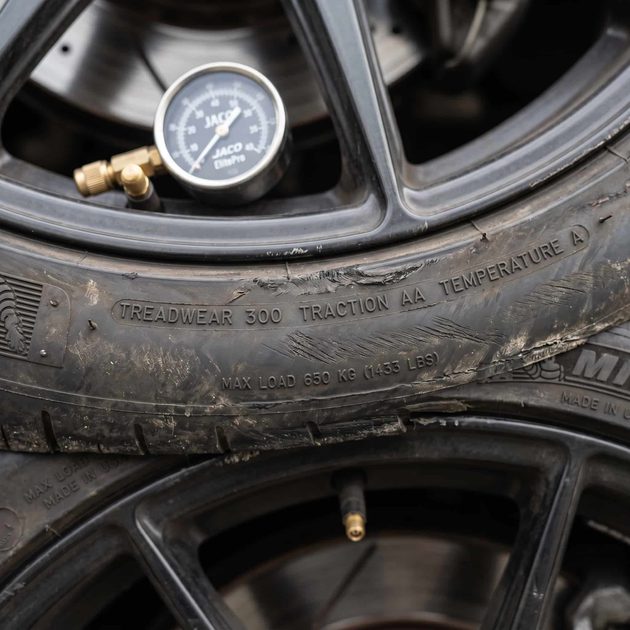
Treadwear Rating
The treadwear rating is a rough guide to compound hardness. A 200-treadwear tire is essentially a track-day tire with enough tread to be street-legal. It will offer enormous grip when warm but wear out quickly, perform poorly in the wet, and ride harshly. A 300- to 340-treadwear summer performance tire — Michelin Pilot Sport, Continental ExtremeContact, Goodyear Eagle F1 — offers 80 percent of the grip with far better wet performance, longer life, and more progressive breakaway characteristics. For a street car that sees rain and cold mornings, the 300-range tire is the smarter choice.
Climate
If the car sees temperatures below 40 degrees Fahrenheit, summer tires lose grip significantly. The compound stiffens. The tread cannot conform to the road. A car on summer tires in cold weather is genuinely dangerous. If the car is driven year-round in a four-season climate, a set of ultra-high-performance all-season tires — or a dedicated summer and winter setup — is not optional. It is a safety requirement.
Sidewall Stiffness
A tire with a stiff sidewall transmits steering input more directly. It also rides more harshly. A tire with a softer sidewall absorbs road imperfections better but feels less precise. On a street car that sees broken pavement, some sidewall compliance is an asset, not a weakness. Match the sidewall stiffness to the road quality. Do not chase the stiffest sidewall available unless your roads are smooth enough to justify it.
Width
Wider is not always better. A wider tire increases rolling resistance, reduces wet-weather hydroplaning resistance, and can make steering heavier and less communicative. The correct width is the one that matches the power level and the wheel width. A 225-section tire on an 8-inch wheel with a proper compound will outperform a 265-section tire on the wrong wheel with a harder compound. Fit the tire to the wheel and the wheel to the car.
The Mod That Pays for Itself
A proper set of performance tires is not cheap. A set of four Michelin Pilot Sport 4S tires in a common size will cost between eight hundred and twelve hundred dollars. That is real money. It is also the only modification on the list that makes the car faster in acceleration, shorter in braking, and sharper in cornering — all at once.
Compare that to a cat-back exhaust that costs a thousand dollars, adds eight horsepower, and changes nothing about how the car stops or turns. Compare it to a set of aftermarket wheels that costs two thousand dollars with tires, when the stock wheels were perfectly functional and the money could have gone to better rubber. The tire is the least exciting purchase and the highest-return investment.
I have seen a stock-power car on good tires outrun a modified car on bad tires through a canyon road. Not because the stock car had more power. Because the driver could trust the grip. He could brake later, carry more speed through the corner, and get on the throttle earlier. The modified car was fighting for traction the whole way, wasting its power advantage in wheelspin and understeer.
The Bottom Line
Before you buy the turbo, look at your tires. Before you install the coilovers, look at your tires. Before you spend another dollar on a part that makes the car louder or stiffer or more powerful, look at the four patches of rubber that are the only reason any of it matters.
If your tires have a treadwear rating above 400, or they have been on the car for more than four years, or they are the same all-seasons the car came with when you bought it — stop. Do not buy anything else. Buy tires. The right ones.
The car will accelerate better, stop shorter, turn sharper, and feel more alive than it did before. And every future modification will work better because the bottleneck has been removed.
Tires are not the exciting purchase. They are the honest one. And in a build that actually works, honesty comes first.