The Upgrade That Nobody Photographs
Brake upgrades are the most misunderstood category in street car modification. The industry sells big brake kits the way it sells wheels — by diameter, by color, by how they fill the space behind the spokes. A set of six-piston calipers with 380-millimeter rotors looks like an engineering achievement. It photographs well. It makes the car feel serious.
I have driven cars with $4,000 brake kits that stopped worse on the street than a car with stock calipers, good pads, and fresh fluid. I have also driven cars with stock sliding calipers and properly chosen pads that inspired more confidence from a cold start than any big brake kit with the wrong compound.
The best first brake upgrade is not the one that impresses people in a parking lot. It is the one that reduces stopping distance, improves pedal feel, and works on the first cold stop of the morning. That upgrade has three parts. None of them require a wheel clearance check.
Why Most Brake Advice Is Wrong
The conversation around brake upgrades has been hijacked by two things: aesthetics and track logic. Neither applies to a street car that sees traffic, cold weather, and panic stops at 40 miles per hour.
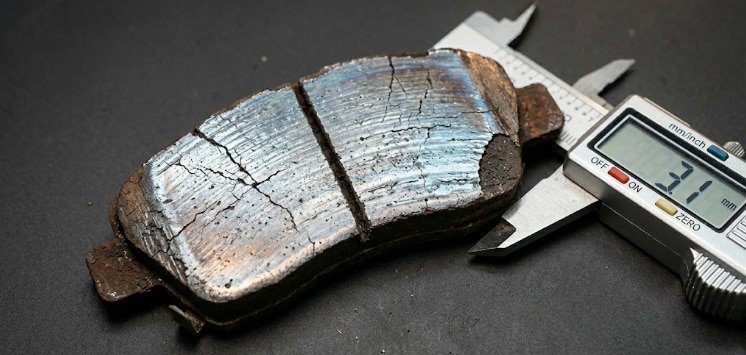
Aesthetics are not a performance metric. A large caliper behind a thin-spoke wheel communicates intent. It does not communicate stopping distance. Some of the most expensive brake kits on the market use pad compounds designed for track temperatures that never arrive during street driving. The pads never reach their operating window. The car stops longer, not shorter.
Track logic assumes repeated 100-to-40-mile-per-hour stops with minimal cooling time. That is not how street braking works. On the street, the hardest stop is usually the first one — a cold panic stop when a car pulls out of a driveway or a light changes faster than expected. A pad that needs heat to bite is a liability in that scenario. A pad that bites cold is an asset.
The other piece of bad advice is that more pistons always mean more stopping power. Stopping power is limited by tire grip, not caliper piston count. If your tires can lock up with the stock calipers, bigger calipers will not stop the car faster. They may provide better modulation, better heat capacity, or better pedal feel, but they will not reduce your single-stop distance. Tires do that. Pads do that. Calipers manage heat.
What Actually Needs to Be Upgraded First
Before spending a dollar on visible hardware, address the components that determine stopping performance in the real world.
1. Brake Pads
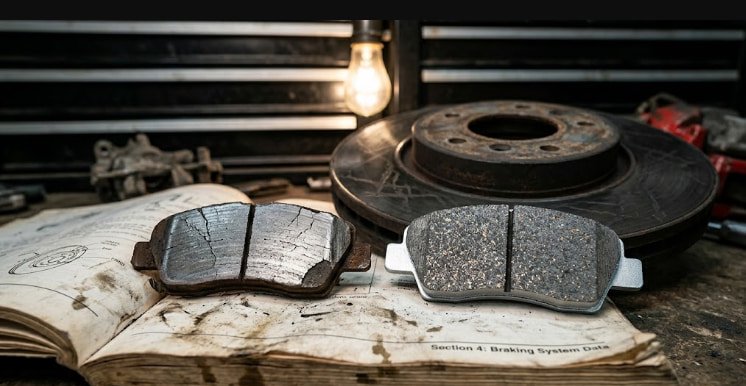
The pad compound is the single most impactful brake modification you can make. A performance street pad from a manufacturer that publishes its friction curves will reduce stopping distance, improve cold bite, and resist fade through a spirited canyon run. Pads in the Hawk HPS, Ferodo DS2500, or StopTech Sport range are designed for exactly this use case: street-driven cars that get driven hard.
These pads sacrifice two things: they produce more dust than factory pads, and they may make more noise when cold. Neither sacrifice affects stopping distance. Both are acceptable tradeoffs on a performance car.
2. Brake Fluid
Brake fluid is hygroscopic — it absorbs water from the air over time. Water lowers the fluid’s boiling point. When the fluid boils, the pedal goes soft, and stopping power disappears. This is not a track-only problem. A car descending a long mountain grade or sitting in stop-and-go traffic in summer heat can push fluid temperatures high enough to expose old, moisture-contaminated fluid.
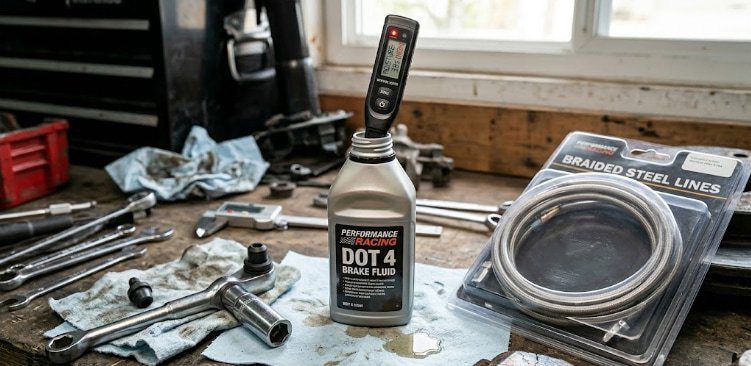
A flush with a high-performance DOT 4 fluid — Motul RBF 600, Castrol SRF, or similar — raises the wet boiling point significantly and costs under fifty dollars. It is the cheapest insurance policy in the brake system. Replace it annually if the car gets driven hard. Replace it every two years regardless.
3. Brake Lines
Factory rubber brake lines swell slightly under pressure as they age. That swelling absorbs pedal force that should be going into the caliper pistons. A set of stainless-steel braided brake lines removes that compliance. The pedal firms up. Modulation improves. The driver feels more connected to what the brakes are doing.
Stainless lines are not a stopping distance reduction on their own. They are a feel and consistency upgrade. Combined with good pads and fresh fluid, they make the brake pedal a precision instrument instead of a suggestion box.
The Upgrade Sequence Table
Priority | Component | What It Improves | Approximate Cost |
|---|---|---|---|
1 | Performance street pads | Cold bite, stopping distance, fade resistance | $150 – $300 per axle |
2 | High-performance DOT 4 fluid | Pedal consistency, boil resistance, safety margin | $25 – $50 for full flush |
3 | Stainless braided brake lines | Pedal feel, modulation, long-term consistency | $100 – $200 for full set |
4 | Stock rotor replacement if worn | Heat capacity, vibration resistance, pad life | $200 – $400 per axle |
5 | Big brake kit | Heat capacity for sustained track use | $2,000 – $5,000 |
Steps one through four address real street braking needs. Step five is for a car that sees track time or sustained high-speed driving where heat management becomes the limiting factor. Most street cars never reach the thermal limit of a stock brake system with good pads and fluid.
When a Big Brake Kit Actually Makes Sense
I am not opposed to big brake kits. I have installed them on customer cars that needed them. A car that sees track days, or a heavy car with significant power increases, may genuinely benefit from the thermal mass and heat dissipation of a larger rotor and a multi-piston caliper. The key word is “thermal.” A big brake kit solves a heat problem. It does not solve a pad compound problem or a fluid maintenance problem.
If you are not boiling fluid or experiencing pad fade after repeated hard stops, a big brake kit is not your next upgrade. Pads, fluid, and lines are. Spend the remaining budget on tires. The brakes only stop the wheels. The tires stop the car.
The Test That Proves the Point
I once did a back-to-back comparison for a customer who was convinced he needed a four-piston caliper upgrade. His car was a 400-wheel-horsepower street sedan on summer tires. Stock sliding calipers front and rear. We did three stops from 60 miles per hour with the stock pads, measured the distance with a GPS performance meter. Then we installed a set of performance street pads, flushed the fluid with fresh DOT 4, and repeated the test on the same road, same tires, same conditions.
The stopping distance dropped by nearly nine feet with only pads and fluid. Nine feet is the difference between a close call and a collision. The customer bought pads, fluid, and lines. He still drives the car with stock calipers.
The Bottom Line
The best first brake upgrade is invisible. It does not change the look of the car. It changes what happens when you press the pedal hard at 60 miles per hour with cold rotors and a full load of fuel. It is pads that bite, fluid that does not boil, and lines that do not swell.
Do the unglamorous work first. Then decide if you actually need more caliper. Most of you will not. The car will stop shorter, feel sharper, and cost you less than a set of red six-piston calipers that never get hot enough to work.
Good brakes are not a visual accessory. They are a commitment to arriving alive. Honor that commitment with the right parts in the right order.