The Suspension Question Every Builder Faces
The suspension aisle is loud. Forums scream that coilovers are the only real upgrade. Budget pages promise a transformed car for two hundred dollars and a set of lowering springs. Social media rewards the lowest ride height with the most attention. In the middle of all that noise, a builder stands in his garage, holding a credit card, unsure which direction to go.
I have answered the question more times than I can count: “What suspension should I buy?” The answer is never the same, because the correct suspension is not a product. It is a decision that matches a specific car to a specific set of roads and a specific set of expectations. The wrong choice will make the car miserable. The right choice will make it feel alive.
This piece is a decision guide, not a product recommendation. I will not tell you to buy coilovers because they look serious. I will not tell you to stay stock because modifications are risky. I will give you the framework I use when I build a street car, and then you will know which direction fits your life.
What the Options Actually Mean
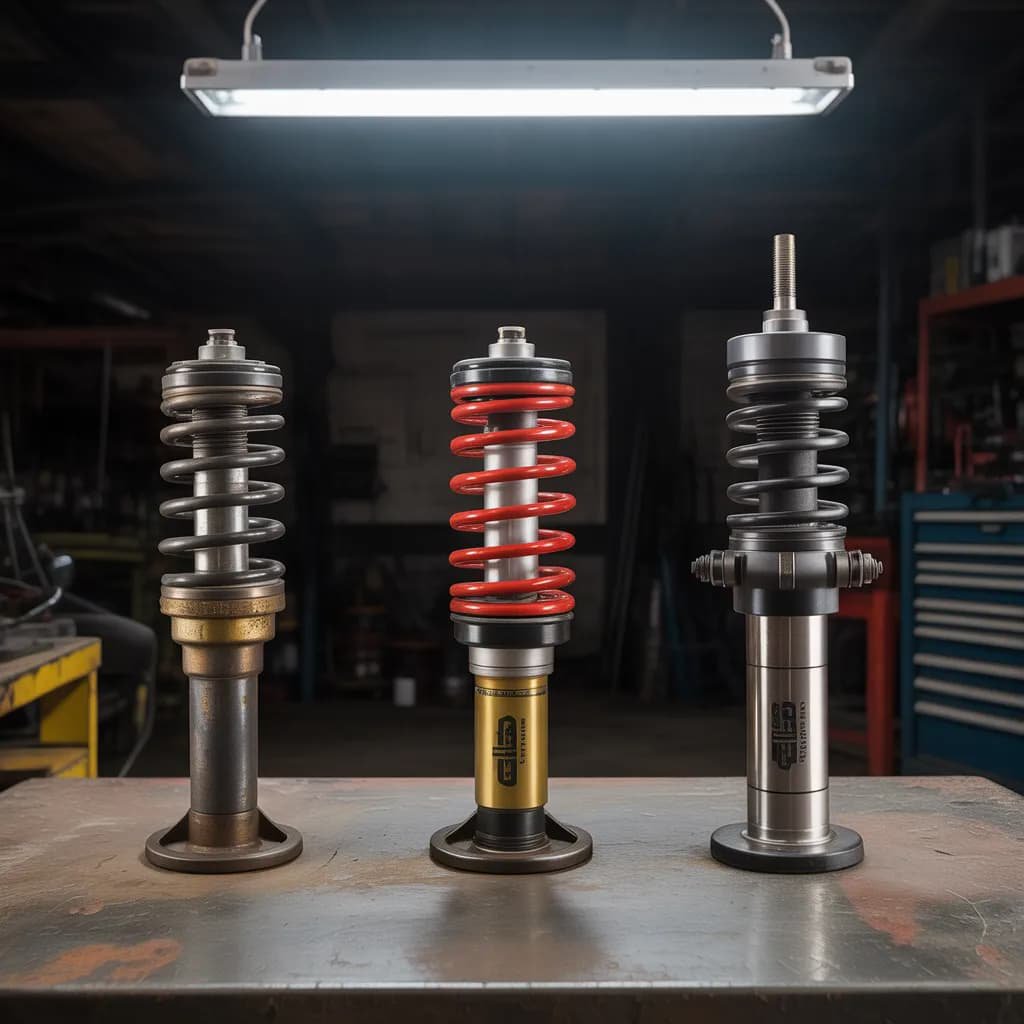
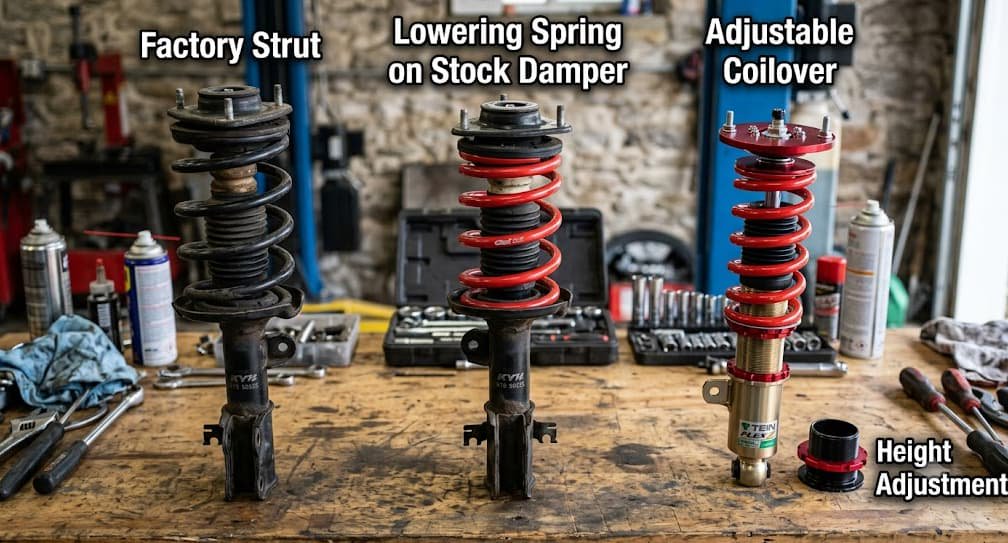
There are three paths. Each path solves a different problem. The mistake most builders make is choosing a path based on price or appearance instead of problem-solving.
Coilovers
A coilover is a matched spring and damper assembly with an adjustable spring perch that allows ride height changes. Good coilovers offer adjustable damping. Excellent coilovers are valved for a specific spring rate range and maintain that valving for tens of thousands of miles. Cheap coilovers are worse than stock dampers with a fresh set of springs.
Coilovers solve a specific set of problems: the need to set exact ride height, the need to adjust damping for different surfaces, and the need to fit wider wheels and tires. They are the most capable option and the easiest to get wrong.
Matched Springs and Dampers
A performance spring and damper combo — a set of Eibach springs paired with Koni Yellow dampers, or a Bilstein B12 kit, or similar factory-engineered systems — solves a different problem. The ride height is fixed, usually a moderate drop. The damping is fixed and tuned to the spring rate. The driver installs them, gets an alignment, and does not touch them again.
This path is for builders who want a sharper, more composed car without the responsibility of adjusting and maintaining a coilover system. It is the most overlooked option in the aftermarket and, for many street cars, the best one.
Leave It Alone
Refreshing the factory suspension with new OEM or equivalent dampers, mounts, and bushings is not a concession. It is an honest answer to a honest question. If the car sees nothing but broken pavement, traffic, and the occasional on-ramp, the factory suspension — when it is fresh — is often the most livable and predictable setup available. A worn-out factory suspension is not the same as a functioning factory suspension.
The Decision Table
Option | Best For | Typical Cost (Parts) | Adjustability | Ride Quality | Performance Gain Over Stock | Maintenance |
|---|---|---|---|---|---|---|
Coilovers | Mixed street and track use, specific ride height targets, wheel fitment needs | $1,200 – $3,000+ | Ride height, damping (on most) | Firm to harsh, depending on valving and setup | High, if properly corner-balanced and set | Requires periodic inspection, eventual rebuild |
Matched Springs and Dampers | Spirited street driving, no desire to adjust, predictable performance | $800 – $1,500 | None | Firm but compliant, generally well-tuned | Good to excellent for street use | Minimal, install and forget |
OEM Refresh | Pure daily driving, rough roads, tight budget, family car duties | $200 – $600 | None | Comfortable and compliant | Restores stock capability, no gain | Minimal |
This table is not a ranking. It is a fitment guide. A car that lives in Brooklyn and never sees a track has different needs than a car that runs canyon roads every weekend. The goal is not to buy the most expensive option. The goal is to buy the option that matches your actual life.
How to Choose: The Three Questions
I ask every builder three questions before a suspension part gets ordered. The answers eliminate options quickly.
Question 1: Where do you actually drive?
Not where you want to drive. Where you are. If the roads are broken, crowned, patched, and littered with potholes, you need suspension travel and compliance. A slammed coilover setup will make the car undriveable. If the roads are smooth and winding, you can tolerate a firmer, lower setup.
Question 2: What is the car’s job?
A daily driver that carries a car seat needs different suspension than a weekend toy. A car that sees highway commuting needs different damping than a car that lives on back roads. Define the job. The job dictates the setup.
Question 3: How much do you want to maintain it?
Coilovers need attention. Ride height settles. Damping adjustments can get bumped. Corner balancing is a real process. Matched springs and dampers go on and get forgotten. A factory refresh lasts another 80,000 miles. Choose the maintenance burden you are willing to carry.
When Coilovers Make Sense
Coilovers are the right choice when you need control. If you are corner-balancing the car for track use, or you need to set ride height precisely to clear a specific wheel and tire package, or you want the ability to adjust damping for different surfaces, a quality coilover system is the tool for the job.
The key word is quality. A sub-thousand-dollar coilover kit is, in my experience, a liability. The dampers are valved for a wide range of spring rates and control none of them precisely. The adjusters seize. The damping degrades within 15,000 miles. A cheap coilover is worse than a good spring-and-damper combo at the same price.
If the budget does not allow for a set of coilovers from a manufacturer that publishes damper dyno plots and offers rebuild services, do not buy coilovers. Buy the matched spring-and-damper kit and enjoy a car that actually works.
When a Spring-and-Damper Combo Is the Smarter Move
For the vast majority of street-driven performance cars, a matched spring-and-damper combo is the sweet spot. The drop is moderate — usually three-quarters of an inch to an inch and a quarter. The spring rate is stiffer than stock but not punishing. The damper valving is tuned to the spring by engineers who have done the work. There are no knobs to fiddle with and no ride height collars to seize.
I have installed this type of setup on dozens of cars. The owners are consistently satisfied in a way that budget coilover buyers are not. The car turns in sharper, rolls less, and still absorbs bridge joints and potholes. The ride quality is firmer but not brittle. The car feels European in its composure, even when the platform is American or Japanese.
This path does not photograph as well as a slammed coilover car. It will not win stance awards. What it will do is make the car better every time you drive it, which is the point of building a car in the first place.

When You Should Leave It Alone
Not every car needs a suspension upgrade. If the car is a daily commuter that sees traffic and potholes and carries passengers, the best suspension upgrade may be new factory-equivalent dampers, fresh mounts, and a set of performance tires. The ride quality stays comfortable. The ground clearance stays functional. The car does not become a compromise.
If the budget is tight, do not buy cheap lowering springs and call it an upgrade. Save the money. Replace what is worn. Drive the car. A car with fresh stock suspension and good tires is more capable than a car with blown factory dampers and cheap coilovers.
Leaving it alone is not giving up. It is recognizing that the car already does its job, and the money is better spent elsewhere — on brakes, on tires, on seat time.
The Bottom Line
The suspension is not a status symbol. It is a system that keeps the tires in contact with the road. The right choice is the one that matches your roads, your driving, and your willingness to maintain the setup.
If you need adjustability and plan to use it, buy the best coilovers you can afford. If you want a sharper car without the burden of adjustment, buy a matched spring-and-damper kit. If the car already works for your life, refresh the stock components and drive it.
Do not let a forum post or a parking lot photo make the decision for you. The car has to live with the choice. So do you. Choose what works, not what impresses.