
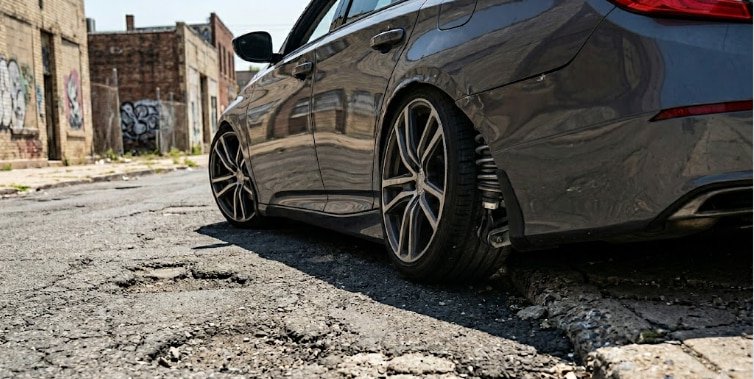
The Look vs. The Reality
I understand why people lower their cars. A car with a tight wheel gap looks serious. It looks like it means business. It looks like the kind of machine that corners flat and pulls hard and does not apologize for any of it. The visual promise is strong. I get it.
The mechanical reality is less photogenic. Lowering a car changes its suspension geometry in ways that can reduce grip, increase bump steer, and make the car feel nervous instead of sharp. The same modification that makes the car look faster can make it behave slower. I have corrected this on enough customer cars to know the pattern cold: the owner lowers the car, expects transformation, and ends up with a car that skips mid-corner and tramlines on the highway.
This is not an argument against lowering. It is an argument against lowering without understanding what you just changed. A ride height reduction done correctly — with the right supporting parts and a proper alignment — can produce a car that handles better than stock. Done cheaply, it produces a car that fights itself.
What Lowering Actually Changes
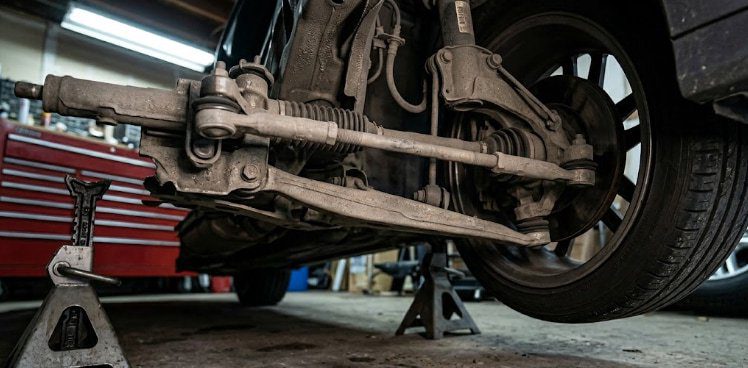
When you reduce ride height, you are not just moving the body closer to the ground. You are moving every suspension pivot point relative to every other pivot point. The control arms, tie rods, and camber links all occupy new angles. The roll center — the imaginary point around which the body rolls in a corner — migrates, often downward and in an unpredictable direction. The camber curve, which governs how the tire’s contact patch changes as the suspension compresses, is altered. The bump steer curve, which determines whether the front wheels toe in or out under compression, shifts.
The factory spent millions of engineering dollars defining these relationships. A set of lowering springs can undo them in an afternoon.
Roll Center
The roll center is the pivot point for body roll. On most MacPherson strut and double-wishbone suspensions, the front roll center drops faster than the center of gravity when the car is lowered. This increases the distance between the roll center and the center of gravity. That distance is called the roll couple. A longer roll couple means more body roll, not less — the opposite of what the owner expected. The car leans harder in corners despite sitting lower to the ground.
Camber Curve
A well-designed suspension gains negative camber as it compresses. This keeps the outside tires flat against the road when the body rolls in a corner. Lowering the car shifts the starting point on that camber curve. On many strut-type front suspensions, the camber curve goes positive after a certain amount of compression. A car that is too low can end up cornering on the outer shoulder of the tire, reducing the contact patch precisely when grip is most needed.
Bump Steer
Bump steer is the change in toe angle as the suspension moves through its travel. The factory designs the tie rod length and steering rack position so that toe change is minimal through the stock suspension range. Lowering the car pushes the tie rods into an angle they were not designed for. The wheels toe in or out under compression and rebound, and the car steers itself over bumps. This is the nervousness that drivers feel but struggle to name. The car hunts and darts on uneven pavement. That is bump steer. It is not a personality trait. It is a geometry error.
Suspension Travel
Lowering the car reduces the distance between the chassis and the bump stops. On a significant drop without shortened dampers or raised upper mounts, the suspension is riding on or near the bump stops even at rest. A bump stop is a progressive spring, but it is not a comfortable one. When the suspension contacts the bump stop mid-corner, the spring rate spikes instantly. The result is snap oversteer or understeer that the driver did not ask for and cannot predict.
The Table of Lowering Costs
What They Wanted | What Lowering Did |
|---|---|
Less body roll | More body roll from a lowered roll center |
More cornering grip | Less grip from a compromised camber curve |
Better steering feel | Nervous steering from bump steer |
A stiffer, sportier ride | Riding on bump stops, unpredictable spring rate spikes |
Better looks | Achieved — at the cost of everything above |
The right-hand column is not hypothetical. I have measured it on alignment racks and felt it on test drives. The car that looked faster was slower through every corner that had a bump in it.
The Right Way to Lower a Street Car
Lowering can work. It can produce a car that handles with more precision and feels more connected. It requires more than springs.
Step 1: Define the Purpose
Are you lowering for aesthetics, for handling, or for both? Answer this honestly. If the answer is aesthetics, accept that you may lose some mechanical performance and build accordingly. Do not pretend a slammed car is a track car. If the answer is handling, stay within the suspension geometry’s functional range — usually a 1.0 to 1.5 inch drop on most platforms, not a 3-inch tuck.
Step 2: Choose Matched Dampers and Springs
I covered this in the last piece. It bears repeating. Lowering springs on factory dampers produce an underdamped, bouncy car. A matched coilover system or a performance spring-and-damper package from a manufacturer that validates the pairing will control the spring properly and provide acceptable ride quality.
Step 3: Correct the Geometry
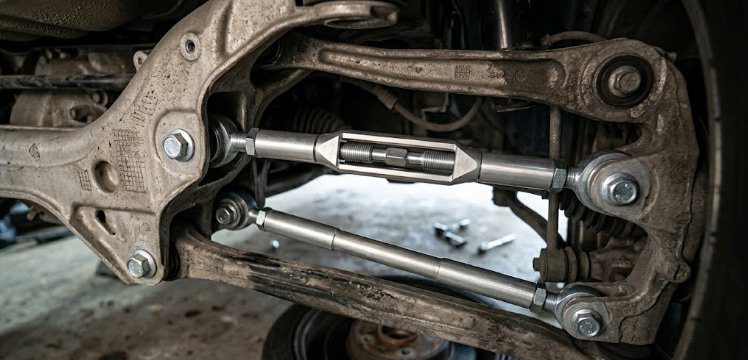
This is the step most people skip. It is also the step that separates a car that handles from a car that just looks low. Depending on the platform, you may need roll center correction ball joints or control arms, bump steer correction tie rod ends, camber plates or adjustable camber arms, and rear toe links. These parts restore the suspension geometry to a functional range after the ride height change. They are not optional if you want the car to handle better than stock.
Step 4: Set Ride Height Realistically
The lowest setting on a coilover is not a recommendation. It is the limit of the adjustment range. Set the ride height so the suspension has adequate bump travel before engaging the bump stops. On most street cars, this means the lower control arms should be roughly parallel to the ground at rest, not angled upward. A car with no suspension travel is not a performance car. It is a skateboard with an engine.
Step 5: Get a Performance Alignment
Lowering changes toe, camber, and caster. A proper alignment from a shop that understands performance geometry is mandatory. Set toe to zero or slight toe-in at the front for stability. Set rear toe to slight toe-in to prevent snap oversteer. Set camber to a value that keeps the tire contact patch flat under cornering load. Do not max out negative camber because it looks aggressive. Too much negative camber reduces braking grip and accelerates inner tire wear.
The Cars That Get It Right
The best-handling lowered street cars I have driven share common traits. They sit at a reasonable ride height, not the lowest possible setting. Their control arms are corrected to restore geometry. Their dampers are valved for the spring rates they run. Their alignment sheets show deliberate numbers chosen for the roads they actually drive. They ride firmly but not harshly. They corner flat without skipping. They feel planted, not nervous.
None of this requires a track-only suspension budget. It requires patience, research, and the willingness to buy the supporting parts before chasing the look.
The Bottom Line
Lowering a car makes it worse before it makes it better because geometry is not negotiable. You can ignore it for a while. You can tell yourself the car feels fine. But the bump steer, the roll center migration, and the camber curve distortion are happening whether you acknowledge them or not.
The fix is not expensive compared to the cost of building a car twice. Buy the correction parts. Set the ride height within the functional range. Align the car properly. Then drive it.
A car that sits low and corners worse than stock is not built. It is broken, elegantly.