The Intercooler Trap
The logic seems airtight. Hot intake air robs power and invites detonation. A larger intercooler removes more heat. Therefore, the largest intercooler that fits must be the best intercooler.
I have removed enough oversized, underperforming intercoolers to know this logic is expensive and wrong. The intercooler is not a standalone radiator. It is a link in a chain that starts at the compressor outlet and ends at the intake valve. Change one link without considering the others, and the chain breaks in ways the dyno sheet will not immediately reveal.
An intercooler that is too large for the turbo and the driving conditions will increase pressure drop, slow throttle response, and block airflow to the radiator. The intake air temperature reading will look beautiful on a data log. The car will feel lazy, unresponsive, and prone to coolant temperature creep in traffic. The owner will stare at the log and wonder why the car feels worse when the numbers say it should feel better.
The right intercooler does not just lower intake air temperature. It lowers intake air temperature while preserving airflow velocity, minimizing pressure drop, and not stealing cooling capacity from the radiator and oil cooler. That is a harder target to hit. It requires thinking beyond core dimensions.
What an Intercooler Actually Needs to Do
An intercooler has three jobs. Most marketing material only talks about one.
Job 1: Reduce Intake Air Temperature
This is the job everyone knows. Hot air from the compressor outlet passes through the intercooler core. Ambient air flows across the fins and carries heat away. The intake charge entering the throttle body is cooler and denser. The engine makes more power with less risk of detonation. Simple.
Job 2: Minimize Pressure Drop
Every intercooler resists airflow to some degree. That resistance is called pressure drop, measured in psi between the inlet and outlet. A poorly designed core — one with undersized internal passages or a restrictive end tank design — can lose three or four psi at high flow rates. That is boost the turbo already made, and boost the engine never sees. The turbo works harder. The compressor discharge temperature rises. The intercooler removes heat from air that was hotter than it needed to be.
Job 3: Avoid Blocking the Radiator
A front-mount intercooler sits in front of the radiator. It preheats the air that reaches the radiator core. If the intercooler is too tall, too thick, or poorly ducted, coolant temperatures climb. The engine runs hotter in traffic and under sustained load. A car that pulls intake air temperature down while pushing coolant temperature up has not solved a heat problem. It has moved it.
The Selection Table
What They Bought | What They Expected | What Actually Happened |
|---|---|---|
Largest bar-and-plate core that fit the bumper | Lowest intake temps possible | 3 psi pressure drop, turbo lag increased, throttle response softened |
eBay-special intercooler kit | Budget cooling upgrade | End tanks cracked at the welds, core leaked at 18 psi, replaced twice |
Thick core without ducting | Maximum heat rejection | Blocked 60% of radiator airflow, coolant temps rose 15 degrees in traffic |
Tube-and-fin core sized for the turbo | Balanced performance | Intake temps dropped, pressure drop under 1 psi, coolant temps unchanged |
Stock intercooler, heat-soaked in traffic | Expected it to cope with upgraded turbo | Intake temps spiked to 140 degrees after two lights, timing pulled, power vanished |
The right column on the fourth row is what happens when the intercooler is selected as part of a system. The turbo, core, ducting, and radiator all work together. No single component is oversized. No single component is the bottleneck.
How to Choose the Right Intercooler
I have installed intercoolers on cars ranging from stock-turbo daily drivers to fully built street machines. The process I use to select a core has not changed in a decade. It is not based on brand loyalty or peak horsepower claims. It is based on measurable criteria that predict whether the intercooler will work in the real world.
Step 1: Size the Core to the Turbo, Not the Bumper
A turbocharger has a flow rate, measured in pounds per minute or cubic feet per minute. The intercooler core should be sized to handle that flow rate efficiently at the boost pressure the engine will actually run. A core rated for 600 wheel horsepower will not work efficiently on a turbo flowing enough air for 350. The air moves too slowly through the oversized passages. Velocity drops. Throttle response suffers.
Match the intercooler core flow rating to the turbo compressor map. If the manufacturer does not publish flow data, find one that does.
Step 2: Choose the Core Type for the Application
Bar-and-plate cores are durable and offer high thermal mass. They are excellent for drag racing and high-boost applications where weight is less important and peak heat rejection matters most. They are also heavy, slow to shed heat once saturated, and can restrict radiator airflow if too thick.
Tube-and-fin cores are lighter, flow more ambient air through to the radiator, and recover faster after heat soak. They are often the better choice for a street car that sees traffic and varied speeds. The peak heat rejection may be slightly lower, but the system-level performance — intake temps plus coolant temps — is often superior.
Step 3: Check the End Tank Design
The end tanks are where airflow transitions from the charge pipe into the core and back out. Stamped sheet-metal end tanks with sharp internal transitions create turbulence and pressure drop. Cast or fabricated end tanks with smooth internal radii preserve airflow velocity. Look at the inlet and outlet design before looking at the core dimensions. A poorly designed end tank can ruin an otherwise good core.
Step 4: Duct It Properly
An intercooler without ducting is relying on whatever air happens to pass through the bumper. Proper ducting forces ambient air through the core and prevents it from spilling around the sides. This is especially important at low speeds, where natural airflow is minimal. A smaller, well-ducted intercooler will often outperform a larger, un-ducted one in real driving.
Step 5: Log Data Before and After
Install the intercooler. Log intake air temperature, pressure drop across the core, and coolant temperature under the same driving conditions you used before the install. Compare the data. If intake temps dropped but coolant temps rose, the core is too restrictive to radiator airflow. If intake temps dropped but boost response softened, pressure drop may be the culprit. Adjust ducting, or reconsider the core size.
The Intercooler I Keep Recommending
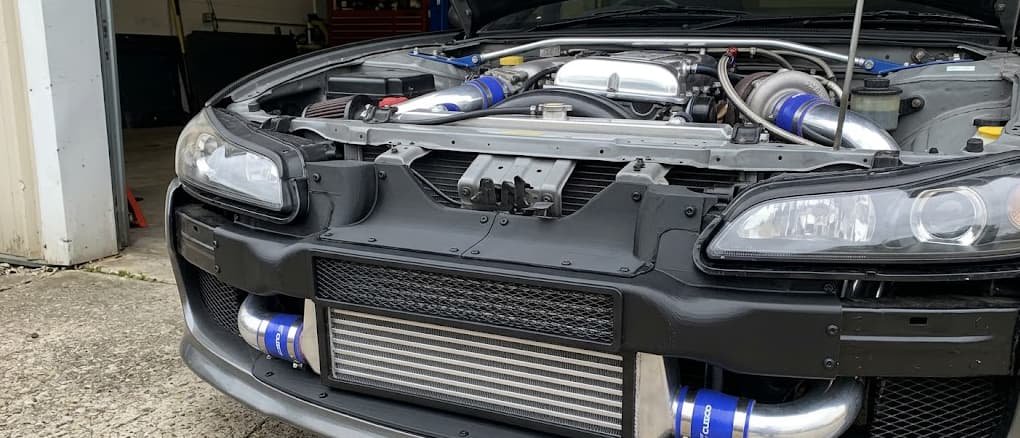
I do not recommend specific products lightly, but there is a configuration I have installed on multiple street-driven turbo cars with consistent results. It is a moderately-sized tube-and-fin core from a manufacturer that publishes flow data. End tanks are cast aluminum with smooth internal transitions. The core thickness is two and a half to three inches — enough to shed heat, not so thick that it chokes the radiator. Ducting is fabricated from ABS sheet and sealed with weatherstrip foam.
On a 400-wheel-horsepower street car, this setup drops intake air temperatures to within 15 degrees of ambient at highway speed and recovers within 30 seconds after a heat-soaked idle. Pressure drop across the core is under one psi. Coolant temperatures are unchanged from stock. The car does not feel laggier. It feels the same at part throttle and stronger at full throttle because the timing tables are not pulling advance to protect against heat.
The setup cost less than a thousand dollars including ducting materials and an afternoon of fabrication. It has been on the car for 40,000 miles. The fins have small bends from road debris. The core does not leak. The welds have not cracked. It solves the heat problem without introducing new ones. That is the standard.
The Bottom Line
The best intercooler is not the biggest one that fits. It is the one that lowers intake temperatures while preserving boost response, minimizing pressure drop, and not cooking the radiator. That requires flow data, ducting, and honest post-install logging — not just a core dimension and a price tag.
If your intercooler made the car feel laggy, or your coolant temperatures climbed after install, or you never logged pressure drop across the core — you have not finished the job. The intake air temperature reading is only one number in a system of numbers. Ignore the rest, and you have traded one heat problem for another.
A good intercooler upgrade is invisible in daily driving and obvious at full throttle. The car does not feel different. It just feels stronger, longer, without the fade that used to arrive on the third pull. That is how you know the part earned its place.