
The Rule That Governs Every Recommendation
I have one rule for recommending a performance part. It is not complicated. I did not read it in an industry white paper or copy it from a media ethics guide. I arrived at it after twelve years of installing parts that looked promising and watching some of them fail in ways the marketing never mentioned.
The rule is this: I do not recommend a part unless I have personally installed it, driven on it for at least a thousand miles, and inspected it after use. No unboxing verdicts. No “first drive” impressions dressed up as a review. No borrowed press-car evaluations. No dyno-only conclusions.
A thousand miles is not an arbitrary number. It is enough distance to expose a coilover’s damping degradation, a brake pad’s cold-bite inconsistency, an intercooler’s heat-soak behavior in traffic, and a clutch’s engagement character once the break-in period ends. It is also enough distance for a part that was installed incorrectly — or was never going to work — to announce itself.
Most parts pass the first hundred miles. Many parts pass the first five hundred. Far fewer parts survive a thousand miles of real roads, bad weather, and heat cycles and still perform the way the box promised.
This rule is not good for business. It limits how many products I can review. It means I turn down parts from manufacturers who want a quick write-up. It means I cannot compete with the release-day review cycle that dominates automotive media. I am fine with all of that. My name is on the article. My name is not for sale.
The Categories Where Testing Matters Most
Some parts reveal their character quickly. A short-throw shifter either feels precise or it does not, and you know within three shifts. Other parts take time to expose their weaknesses. The following categories are where I have seen the largest gap between first impression and long-term reality.
Coilovers and Dampers
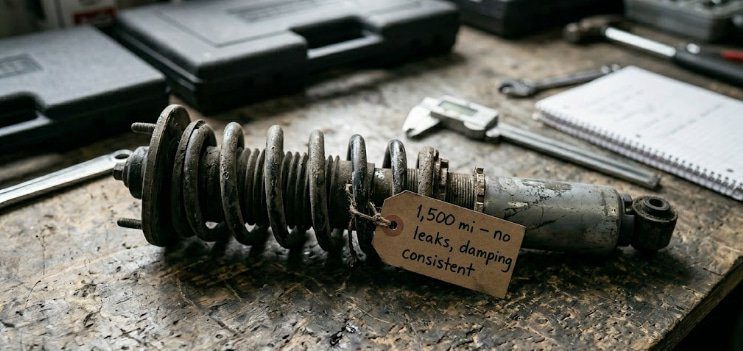
A new coilover feels tight and controlled out of the box. The real test is what it feels like at 8,000 miles. Budget coilovers are notorious for damper fade — the internal valving loses consistency as the fluid shears down and the seals wear. The car that felt sharp on day one starts to feel floaty and underdamped by month six. The owner often does not notice because the degradation is gradual. I notice because I log it.
Brake Pads
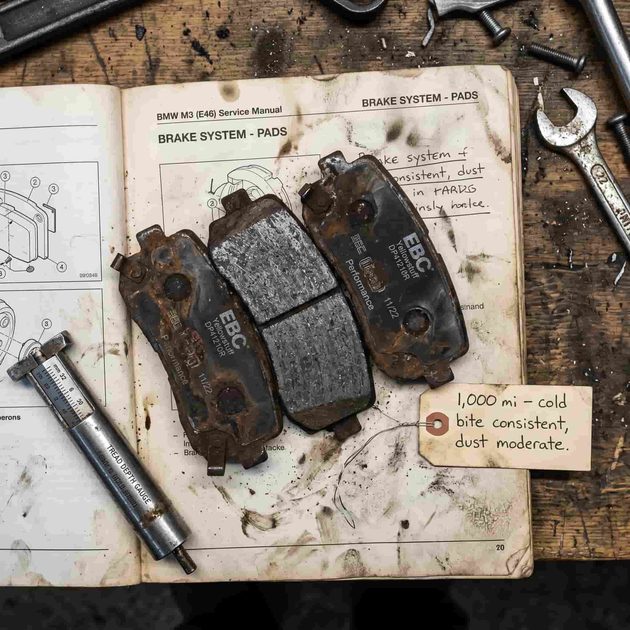
The first stop on a new set of performance pads usually feels good. The tenth cold start at 35 degrees might reveal a pad that needs heat to bite and does not get it on a short commute. I test pads through a full winter if possible. Cold-weather behavior is where many performance compounds fall apart.
Clutches
A new clutch needs a break-in period of 500 to 1,000 miles of normal driving before it can be evaluated. During that period, the friction surfaces bed into the flywheel and pressure plate. Engagement character changes. Pedal effort changes. Chatter may appear or disappear. A clutch review written after 50 miles is a review of the installation, not the product.
Intercoolers
An intercooler tested on a 70-degree day with good airflow looks effective. An intercooler tested in 95-degree stop-and-go traffic with the AC running tells a different story. I log intake air temperatures across multiple driving conditions before I form a verdict. One data log is not a test. It is a snapshot.
Engine Management and Tuning Components
A standalone ECU or a piggyback tuning module can take months to evaluate properly. Cold-start behavior, hot-restart fueling, part-throttle drivability, and closed-loop fuel trim behavior all require time and varied conditions. A tuning product that works perfectly on the dyno can produce hesitation, surging, or check-engine lights after two weeks of mixed driving.
The Testing Table
Part Category | Minimum Mileage Before Recommendation | What I Look For During Testing |
|---|---|---|
Coilovers and dampers | 1,500 miles | Damper consistency, spring sag, bushing wear, ride quality retention |
Brake pads | 1,000 miles | Cold bite, dust accumulation, rotor wear pattern, noise development |
Clutches | 1,000 miles | Engagement consistency, pedal effort change, chatter, high-RPM lockup |
Intercoolers | 500 miles across varied temps | IAT stability, heat soak recovery, pressure drop under sustained load |
Turbo systems | 2,000 miles | Spool consistency, oil leakage, shaft play development, wastegate behavior |
Tuning hardware and software | 1,500 miles | Drivability across conditions, code-free operation, sensor accuracy, update stability |
A part that fails to maintain its initial performance through this testing window does not get recommended. It gets a phone call to the manufacturer and a private explanation of what went wrong. If the manufacturer fixes the issue and I retest, I update the verdict. If they do not, the part never appears on this site.
The Parts That Failed Quietly
I am not going to list every part that failed testing — that would be a different article and a much longer one. What I want to communicate is the pattern. The parts that fail are rarely the ones that looked bad out of the box. They are the ones that degraded silently.
I tested a set of budget coilovers several years ago that felt excellent for the first 2,000 miles. By 5,000 miles, the rear dampers had lost enough rebound control that the car porpoised on undulating highway sections. The springs had settled unevenly. The ride height had dropped another quarter-inch on the driver’s side. The owner, a customer who had bought the kit against my initial advice, thought the car just needed an alignment. It needed new dampers.
I tested a high-flow fuel pump that delivered perfect pressure on the dyno and during street logging for the first 800 miles. At around 1,000 miles, the internal check valve began leaking down after shutdown. The car developed extended cranking times on hot starts. The pump still flowed fuel. It just could not hold pressure in the rail. A reviewer who installed the pump and wrote the article a week later would have called it flawless. I called the manufacturer and asked if they had revised the check valve design. They had not.
These failures do not make for dramatic content. There is no explosion, no catastrophic engine failure, no viral moment. Just slow, quiet degradation that erodes the car’s drivability in ways the owner learns to tolerate rather than diagnose. My job is to not tolerate it.
What This Means for You as a Reader
The practical consequence of this rule is simple. When you read a product recommendation on Iron Gospel Garage, you are reading about a part that has survived my specific, inconvenient, deliberately skeptical testing process. It has been installed in a real car, driven on real roads, in real weather, for enough distance to expose the weaknesses that a press release will never mention.
You are not reading about a part someone unboxed, photographed, and installed the day before a deadline. You are not reading about a part someone drove for 40 miles and declared “a game-changer.” You are not reading about a part someone was paid to recommend, or given for free in exchange for coverage, or asked to review by a sponsor.
The standard is the standard. I did not create it to be difficult. I created it because I have been the guy fixing the car after the bad part failed, and I do not want you to be the guy paying for that repair.
The Bottom Line
A part that works for a week is not a good part. A part that works for a thousand miles of mixed driving, in heat and cold and traffic and rain, and still performs the way the box promised — that is a part worth your money.
I do not care how a part looks in a press photo. I do not care how it feels on a 20-minute test loop. I care what it does after you have forgotten you installed it, because the car just works the way it should.
That is the standard. If a part meets it, I will tell you. If it does not, you will never read about it here.