The Two Tunes You Keep Hearing About
The tuning world splits into two camps. One says a dyno tune is the only professional way to extract power. The other swears a street tune is the only way to make a car actually driveable. Both camps are half right. Both camps miss the bigger point.
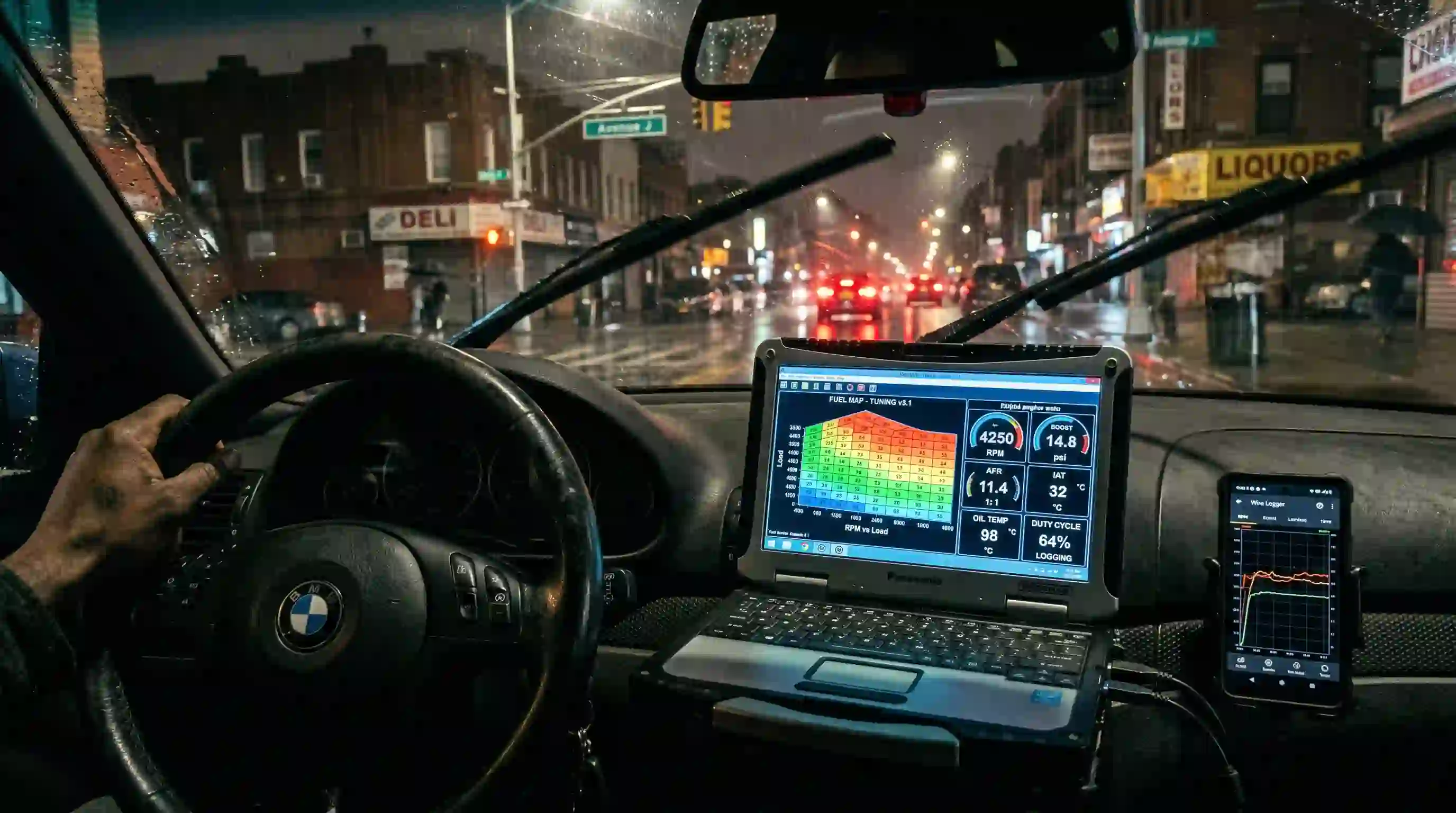
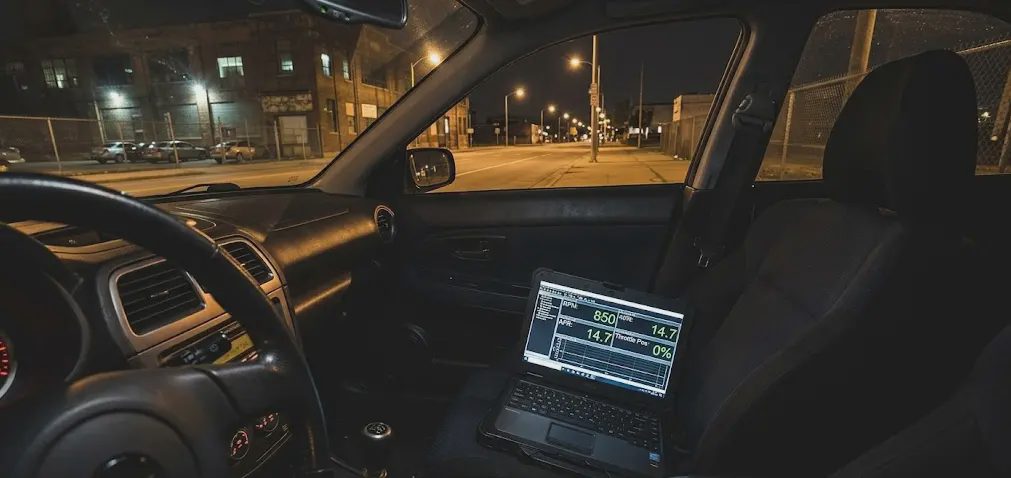
I have tuned cars on a Mustang dyno in a climate-controlled shop. I have tuned cars with a laptop on the passenger seat, logging third-gear pulls on an empty industrial road at 2 a.m. I have also fixed cars that came from “pro tuners” with a dyno graph that looked perfect and a part-throttle hesitation that made the car stumble like it was running on three cylinders.
A tune is not a graph. A tune is a set of instructions your ECU uses to keep the engine alive and responsive across every load condition, every temperature range, and every throttle position you will ever encounter. A dyno only tests a few of those conditions. The street tests all of them.
What a Dyno Tune Actually Gives You
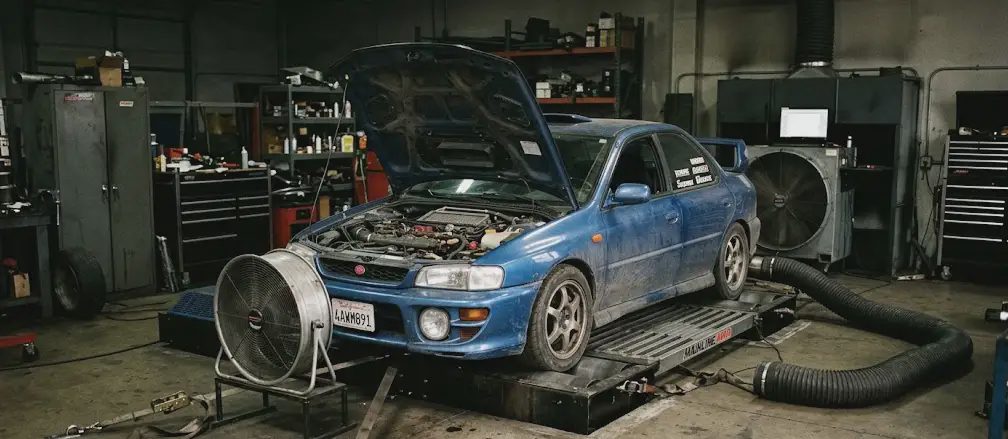
A chassis dyno is a tool. It measures torque at the wheels under controlled load. A good tuner can use a dyno to optimize wide-open-throttle fueling and ignition timing under steady-state conditions. The dyno room is climate-controlled. The intake air temperature is stable. The engine has time to cool between pulls. The load is predictable.
This environment produces a clean graph. It also produces a false sense of security.
A dyno tune is excellent at:
Finding peak power and torque under full load
Optimizing air-fuel ratios at wide-open throttle
Measuring the impact of individual modifications back-to-back
Identifying knock at high RPM in a controlled environment
A dyno tune cannot:
Simulate the heat soak of 45 minutes in traffic before a highway merge
Replicate the airflow over an intercooler at 70 mph on a 95-degree day
Test tip-in throttle response from a closed throttle in second gear at a roundabout
Model the fuel slosh, voltage drops, and transient conditions of real driving
A dyno graph proves the engine can make a number under ideal conditions. It does not prove the car will behave when you ask for half throttle after sitting at a red light for two minutes. That is not a limitation of the dyno operator. It is a limitation of the tool.
What a Street Tune Actually Gives You
Street tuning is not just “doing pulls on the highway.” A real street tune involves hours of data logging across every driving condition the car will see: cold start, warm idle, stop-and-go traffic, part-throttle acceleration in every gear, highway cruise, full-throttle pulls, deceleration fuel cut, and heat-soaked restart.
The goal is not peak horsepower. The goal is behavior. A well-executed street tune addresses:
Cold start enrichment and idle stability
Part-throttle ignition timing and fueling for smooth daily driving
Acceleration enrichment during rapid throttle openings
Heat management through spark correction when intake temps rise
Closed-loop fuel trim behavior during steady-state cruise
Knock sensor activity on imperfect pump gas
These are the things that determine whether a car feels sharp or lazy. These are the things that determine whether you trust the car on a road trip. These are the things a dyno graph never shows.
The Comparison Table
Criteria | Dyno Tune | Street Tune |
|---|---|---|
Peak power optimization | Excellent — steady-state, controlled load | Good — but limited by road length and safety |
Part-throttle drivability | Poor — rarely tested | Excellent — tested across all conditions |
Heat soak behavior | Not tested | Tested repeatedly |
Cold start and idle | Rarely addressed | Addressed in detail |
Transient throttle response | Limited | Thoroughly tested |
Real-world fuel quality | Simulated or unknown | Actual pump gas behavior |
Safety and repeatability | High — controlled environment | Lower — public roads, traffic, and weather |
This table reveals the truth neither camp wants to admit. A dyno tune alone is incomplete. A street tune alone is unsafe for finding peak power. The correct approach is a combination: use the dyno to establish safe full-load fueling and timing, then use the street to refine everything else.
The Horror Story I Keep Seeing
The worst phone calls I received during my years in the New York tuning scene followed the same pattern. A customer had paid for a dyno tune at a shop with a big reputation. The graph showed 450 horsepower. The customer was thrilled. A week later, the car was surging at light throttle in traffic. A month later, it threw a check-engine light for fuel trim codes. Three months later, the spark plugs showed signs of detonation that the dyno knock sensors never caught.
The dyno tune gave him a peak number. It did not give him a drivable car. The tuner had spent five hours on the dyno perfecting the wide-open-throttle table and zero minutes logging a hot restart after the engine had been idling in direct sunlight for twenty minutes. That detail — the hot restart — is where the damage happened. Startup enrichment was wrong for a heat-soaked engine. The car ran lean for six seconds on every hot start. Six seconds, repeated hundreds of times over several months, ate away at the ring lands until the engine started consuming oil.
The dyno graph never showed this. The street logs did. But nobody collected them.
What I Recommend
If you are serious about making power that lasts, you need both environments. Here is the sequence I use for every build I trust.
Phase 1: The Dyno Baseline
Establish safe wide-open-throttle fueling and timing. Set the boost target. Confirm torque and horsepower curves. Verify there is no knock under controlled load. This phase is about safety and maximum output at full throttle.
Phase 2: The Street Refinement
Log cold starts. Log part-throttle acceleration at 10%, 20%, and 40% pedal position. Log steady-state cruise at 60 mph. Log a heat-soaked restart. Log tip-in throttle transitions in second and third gear. Adjust acceleration enrichment, closed-loop fuel targets, idle air control, and spark correction tables based on real-world data. This phase is about drivability and long-term reliability.
Phase 3: The Follow-Up Dyno Check
After street refinement, return to the dyno for a final full-throttle verification. Confirm that drivability changes have not compromised peak power. The final result is a tune that performs on the graph and behaves on the road.
This process takes longer. It costs more. It requires a tuner who understands that a car is a system, not a single data point. It also produces a car you can live with for 50,000 miles.
The Bottom Line
A dyno number is a trophy. A street-tested tune is a tool. Buy the trophy if you want a conversation starter. Invest in the tool if you want a car that pulls clean at every RPM, in every gear, on every road you actually drive.
If a tuner hands you a graph and cannot show you a single street log of part-throttle drivability, you do not have a tune. You have a sales receipt.
Good power is usable power. Everything else is just noise.